|
| sent on 30 Giugno 2017
Pros: Sharpness, blur, lightness and compactness to be a 2.8
Cons: There is no stabilizer, but it is a "posthumous"
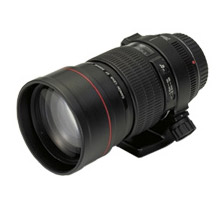
Opinion: Aim of great satisfaction, use and results. I was looking for the first version (1991), a bit because I fixed the dated lenses, a bit because I prefer the appearance and the bayonet lenses, compared to those of the second version. I replaced it with a Sigma Apo-macro 70-300 f4-5.6, and my early embarrassment on switching from a wide-range zoom to a fixed optic fade away immediately after the first use on the field.rn Sharpness And the overall yield are really good too at TA, even at the edges, and they are excellent at f4-5.6-8. All this is accompanied by saturated colors, distinct three-dimensionality and blurry beautiful, soft and creamy, even diaphragmatic. Absent distortion, and very small f2.8 vignetting, which disappears at f4, complete a picture to say the least flattering. The construction is solid, metallic, and there is a dedicated tripod bracket. A real L, in short, you can not wait to be able toAre, and with whom I brought home some of my best shots. Absolutely, I need a medium-sized canvas, I put the 85mm f1.8, for tighter shots this 200 covers most of my needs, and renounces it Practicality and excursion terms compared to the Sigma 70-300 is really nothing compared to the quality of the shots you make, which is right on another planet. It's enormously smaller and lighter than 70-200 f.2.8 (in each version ), The same as the maximum aperture and focal length, and is even smaller than 70-200 f4, with a similar weight (less than 800g including the hood, which is incorporated); I also like the fact that it is more discreet and less palerable than the brother's variable because of the black color (the only EF L non-white cloth ever produced). Also, the budget you bring to your home is really modest (I've spent 350 euros), much more if you consider that the results are just as good quality as the quoted zoom. For a priBut series, like mine, the problem is - ultimately - finding one, and in good condition: well, look for search, I've found it! And it does not succumb to it anymore. It is a shame that it is not free to enter some gap between the lenses. There is only a real limit on the lack of stabilizers, but in 1991 they had not yet invented it (in this sense it is a "posthumous defect "). In essence, once you reach the limit of f2.8 - 1/200, touch up with the ISO, or use a solid support point. Everything else, it's joy! Rnrnrn |


 The following opinions have been automatically translated with Google Translate.
































 JuzaPhoto contains affiliate links from Amazon and Ebay and JuzaPhoto earn a commission in case of purchase through affiliate links.