What do you think about this photo?
Do you have questions or curiosities about this image? Do you want to ask something to the author, give him suggestions for improvement, or congratulate for a
photo that you really like?
You can do it by joining JuzaPhoto, it is easy and free!
There is more: by registering you can create your personal page, publish photos, receive comments and you can use all the features of JuzaPhoto.
With more than 260000members, there is space for everyone, from the beginner to the professional.
|
|
sent on 01 Dicembre 2022 (8:46)
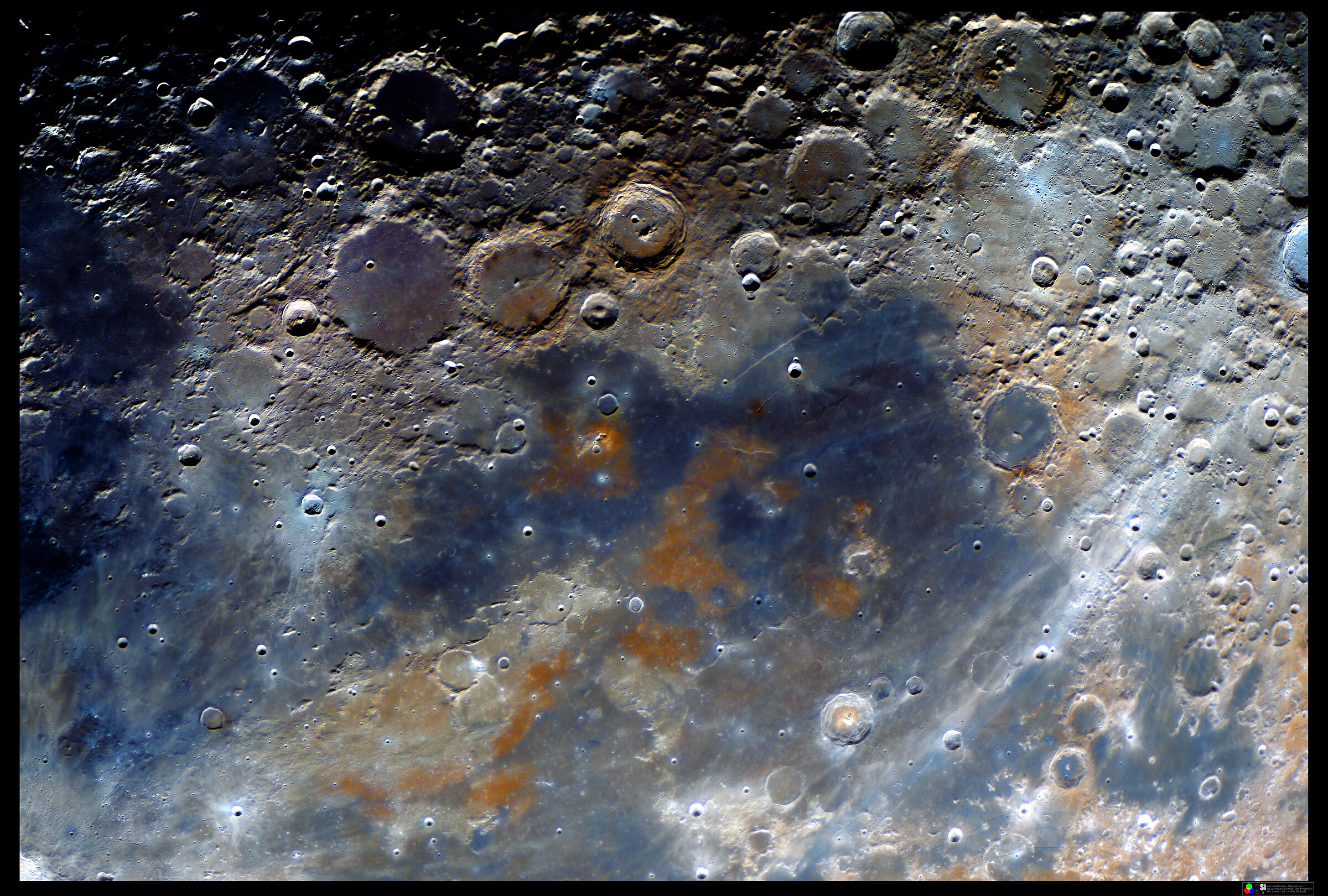
Sono molto contento del risultato in quanto riprendere tutte quelle luminanze è stata una fatica immensa.
Lo stack delle riprese è stato fatto con Autostakkert; La CCE (Chromatic Controlled Enhancement) è stata fatta in Photoshop.
In quest'immagine sono presenti 28 reperi, tutti verificati e confermati, ottenendo quindi un Mineral Score pieno. L'immagine quindi rispecchia i colori ottenuti da LRO e sonda Galileo.
Non so se lo avevo già scritto in precedenza.... in generale, i colori sulla Luna sono dominati dalle variazioni del contenuto di ferro e titanio. Le regioni di mare hanno una bassa riflettanza perché contengono quantità relativamente elevate di ossido di ferro (FeO, colore rossastro). Alcuni basalti di mare contengono quantità insolitamente elevate di ossido di titanio (TiO2, colore bluastro) oltre all'ossido di ferro, il che rende la riflettanza ancora più bassa. Le diverse percentuali di questi ossidi contenute nei minerali sposta il colore dei mari dal rosso al blu. Sono molto contento del risultato in quanto riprendere tutte quelle luminanze è stata una fatica immensa.
Lo stack delle riprese è stato fatto con Autostakkert; La CCE (Chromatic Controlled Enhancement) è stata fatta in Photoshop.
In quest'immagine sono presenti 28 reperi, tutti verificati e confermati, ottenendo quindi un Mineral Score pieno. L'immagine quindi rispecchia i colori ottenuti da LRO e sonda Galileo.
Non so se lo avevo già scritto in precedenza.... in generale, i colori sulla Luna sono dominati dalle variazioni del contenuto di ferro e titanio. Le regioni di mare hanno una bassa riflettanza perché contengono quantità relativamente elevate di ossido di ferro (FeO, colore rossastro). Alcuni basalti di mare contengono quantità insolitamente elevate di ossido di titanio (TiO2, colore bluastro) oltre all'ossido di ferro, il che rende la riflettanza ancora più bassa. Le diverse percentuali di questi ossidi contenute nei minerali sposta il colore dei mari dal rosso al blu. |
|
|
sent on 01 Dicembre 2022 (8:52) | This comment has been automatically translated (show/hide original)
Hello, does that mean that these are the colors we would see from the porthole of a spaceship?
Ciao, vuol dire che questi sono i colori che vedremmo dall'oblò di una navicella spaziale?
|
|
|
sent on 01 Dicembre 2022 (16:21) | This comment has been automatically translated (show/hide original)
Beautiful recovery, congratulations
Gp Bella ripresa, complimenti
Gp |
|
|
sent on 01 Dicembre 2022 (16:56) | This comment has been automatically translated (show/hide original)
Thanks for the explanation, bye. Grazie per la spiegazione, ciao. |
|
|
sent on 01 Dicembre 2022 (18:05) | This comment has been automatically translated (show/hide original)
Crazy photo, very interesting also your description compliments Foto pazzesca, molto interessante anche la tua descrizione complimenti |
|
|
sent on 01 Dicembre 2022 (18:47) | This comment has been automatically translated (show/hide original)
thanks Jste70 :-)
I would add again that the Lassell Massif in the Mare Nubium (in the center of the image, with a blue spot), of a characteristic orange color, is a mountain complex of ancient lava flows, volcanic craters and perhaps a cover of pyroclastic material (ash). This area and the surrounding regions have a complex volcanic history. The southern half of the massif absorbs more UV rays than the northern half, making it redder.
Inside this red-orange "pool" there is Lassell D, recognizable by the blue spot. You can't see it in my image, but in LRO's image, a vast spider's web-like ray is evident.
grazie Jste70 
Aggiungo ancora che il Massiccio Lassell nel Mare Nubium (al centro dell'immagine, con uno spottino azzurro), di un caratteristico colore arancione, è un complesso montuoso di antiche colate laviche, crateri vulcanici e forse una copertura di materiale piroclastico (cenere). Questa zona e le regioni circostanti hanno una complessa storia vulcanica. La metà meridionale del massiccio assorbe maggiormente i raggi UV rispetto alla metà settentrionale, rendendola più rossa.
All'interno di questa "pozza" rosso-arancio c'è Lassell D, riconoscibile per la macchia azzurra. Nella mia immagine non si vede, ma in quelle di LRO è evidente una vasta raggiera simile a una ragnatela.
|
|
|
sent on 05 Dicembre 2022 (23:20) | This comment has been automatically translated (show/hide original)
Congratulations beautiful photo :-) Complimenti bella foto |
|
|
sent on 06 Dicembre 2022 (9:00) | This comment has been automatically translated (show/hide original)
thank you very much Hugo :-)
even if "photo" is a bit simplistic, given the amount of information it brings, the work involved to obtain it and the purposes for which it was conceived :-)
In our group we call them rather "tables"; if you notice at the bottom right it also bears a small "info bar" that contains a series of technical information (how the shots were made, the degree of reliability and consistency of the image, etc.). grazie mille Hugo
anche se "foto" è un po' riduttivo, data la quatità di informazioni che reca, il lavoro impiegato per ottenerla e le finalità per cui è stata concepita
nel nostro gruppo le chiamiamo piuttosto "tavole"; se noti in basso a destra reca anche una piccola "info bar" che contiene una serie di informazioni tecniche (come sono state eseguite le riprese, il grado di affidabilità e coerenza dell'immagine, ecc). |
|
|
sent on 12 Novembre 2023 (7:20) | This comment has been translated
Nice! |
|

Publish your advertisement on JuzaPhoto (info) |



 JuzaPhoto contains affiliate links from Amazon and Ebay and JuzaPhoto earn a commission in case of purchase through affiliate links.


 Resize to fit window
 59.5 MEGAPIXEL


![[en]](shared_files/layout/country_flags/flag_196.jpg)