Mallard at high ISO
Mallard at high ISO, text and photos by
Juza. Published on 08 Giugno 2012; 0 replies, 5163 views.
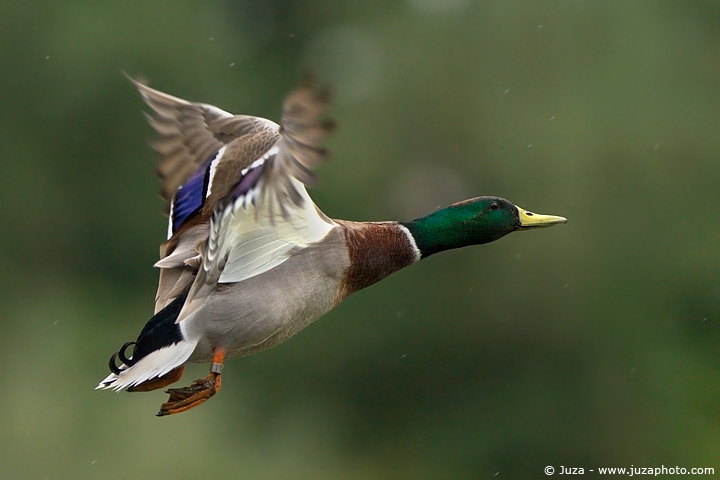
Canon EOS 20D, Canon EF 300mm f/2.8 L IS USM, 1/2000 f/2.8, iso 800, handheld. Racconigi, Italy.
This is one of the first photos that I've taken with the Canon 20D, few months ago. It was a dark, cloudy day, and I was photographing from the hide of Racconigi under a light rain. Mounted on my camera, there was one of the most beautiful lenses ever produced my Canon - the 300 2.8 L IS USM. This is an extremely sharp lens, it has a super fast autofocus and it is easily handholdable...compared to the 600 f/4, it is featherweight.
I set the camera on ISO 800 and the the lens on f/2.8 to get a fast shutter speed and a nice background. Many photographers tend to stop down too much, while it is possible to photograph well many subject even with very wide apertures, as f/2.8 or f/4. Of course, the focus must be perfect! Here, the camera focussed on the neck of the subject and, since it is parallel to che camera, it is sharp from the tip of the tail to the bill. The tips of the wings are slightly out of focus and blurred by movement, but in my opinion they don't detract from the photo - in wildlife photography, it is essential to have the eye of the subject in sharp focus, while usually the tips of the wings or the tail don't detract too much from the photo, even if they are out of focus (but they much not be clipped!).
ISO 800 was essential to freeze the fast motion of the subject in action, and the good noise characteristics of the 20D helped to get good image quality. I often stress the importance of high ISO; between the various cameras that I've tried, the recent Canon cameras (i.e. the models announced from 2004) are the best, and, in my opinion, the difference is evident even at ISO 200 or 400. At ISO 800 or 1600, the difference are substantial. Of course, if you make a small print of the out-of-the camera photo, the differences between the Canons and other brands are much reduced. But if you need to make significant processings (crop, adjustments of contrast, color and saturation), the noise is strongly amplified, and the advantage of Canon cameras become important.
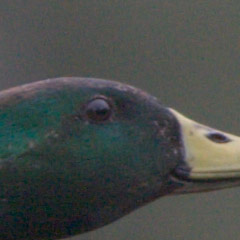
Unprocessed crop from original photo, just converted from RAW to JPEG
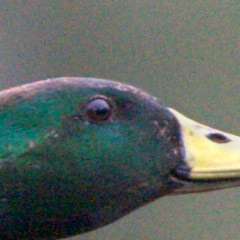
The same crop, with the basic adjustements of contrast and saturation.
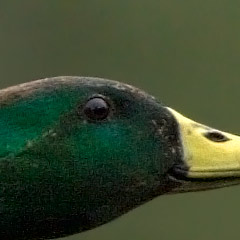
The crop from the final photo. There is just a little of noise in the shadows. The crops above illustrated three steps of my processing workflow. The first crop is the photo converted from RAW with my usual settings (very low contrast, low saturation and no sharpening or noise reduction to preserve the maximum detail). Even at ISO 800, the noise is quite low. The second crop is the photo after the first adjustments of contrast and saturation: the image is enhanced, but the noise is much more visible. The third crop shows the final image: it is easy to eliminate the noise from background; there is still a bit of noise on the mallard since I applied little noise reduction on the subject (I use the layer mask to apply a different intensity of noise reduction on background and subject), but overall the image quality is pretty good considering the situation, and the noise would be barely visible in print.
Replies and comments
What do you think about this article?
Do you want to tell your opinion, ask questions to the author, or simply congratulate on a particularly interesting article?
You can join the discussion by joining JuzaPhoto, it is easy and free!
There is more: by registering you can create your personal page, publish photos, receive comments, join discussions and you can use all the features of JuzaPhoto.
With more than 260000 members, there is space for everyone, from the beginner to the professional.

 JuzaPhoto contains affiliate links from Amazon and Ebay and JuzaPhoto earn a commission in case of purchase through affiliate links.
