Gull in sunset light
Gull in sunset light, text and photos by
Juza. Published on 07 Giugno 2012; 0 replies, 3917 views.
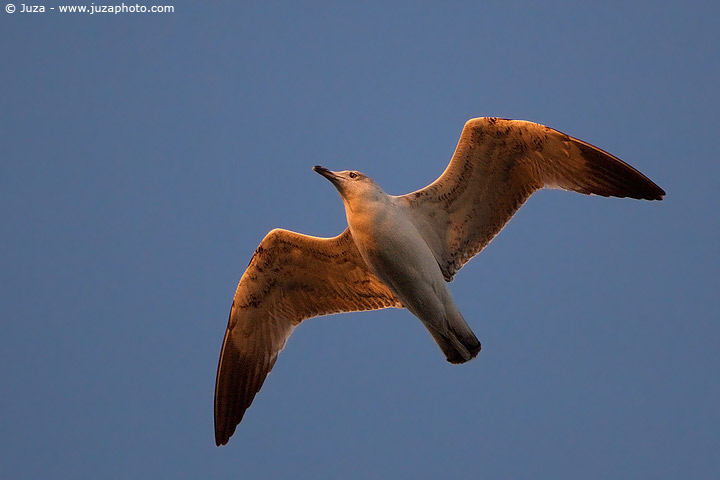
Canon EOS 20D, Canon EF 600mm f/4 L IS USM, 1/1600 f/4, iso 400, handheld. Entella river, Italy.
Many times the photographers forget or misunderstand one of the most important aspects of photography: the light. The "good light" is not the bright, while light of sunny days....the good light is the light of early morning or late afternoon, when the light becomes soft and warm. Whenever possible, I try to photograph at the edges of the day: this photo is taken few minutes before sunset, on the estuary of the Entella river.
The Entella is a small river between Chiavari and Lavagna, fourteen kilometers from Genova. I discoverd this place thank to my friend Christian - he often told me about the gulls and the other birds of the Entella, so yesterday I decided to visit the place. After a short walk, I reached the estuary...it is not a beautiful place, it is close to the railway and the highway, and the beach is quite polluted. Nevertheless, I was amazed by the quantity of birds - there were hundred of gulls!
Even though it was possible to get low on the ground, I preferred to stay up, handholding the 600. It is an heavy beast but I was able to handhold it for few hours, of course with many short pauses. The image stabilization is an huge help - it reduces a lot the hand shake and it makes much easier to frame the subject. The most difficult thing was to find the subject: the 600 f/4 has a very narrow angle of view, and you need some experience to catch quickly the subject, in particular when it is moving fast. I've set the camera on AFPS...in this situations (birds in flight agains the sky), AFPS truly shines - it rarely missed the subject. If I had used MFPS with central AF area as my usual, it is likely that many photos would have been out of focus, since it was extremely difficult to keep a single AF area on the subject.
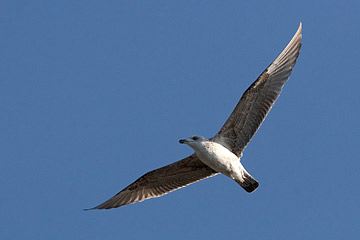
The same species, photographed at midday. The harsh light detracts a lot from the photo. begun to photograph at 11 a.m., as soon as I arrived, with the 600 f/4 and 1.4x TC. When I reviewed the first shots in the LCD screen (at the maximum magnification) I was a bit surprised: all the photos were very soft, with strong chromatic aberration. At first I tought that the lens or the TC were dirty, but I cheched them and they were clean. Then, I realized that the cause of the bad image quality was the heat - even though we are at the end of November, it was a pretty warm day, and between 11 a.m. and 2 p.m. the temperature was truly warm (I was sweating!), and the atmospheric heat ruined the photos, since I was photographing distant subjects with a supertele and there was a lot of (hot) air between the lens and the subject. Anyway, even in cool days, the photos taken in the middle of a sunny day are often quite bad - the light is way too harsh.
Later in the afternoon the light begun to improve, and the air become gradually cooler. The gulls were flying back and forth from the river to the sea, passing right above my head. I set the iso and the aperure to get a shutter speed of at least 1/1000, and every time that a gull come close I toke a burst of 5 or 6 photos. It has been quite funny to handhold the 600...it is far from easy (if you are going to handhold regularly the supertele, the 500 f4 might be a better choice, to handhold the 600 you need to be quite fit), but it gives great results for flight shoots, since you have a great freedom of movement.
Few minutes before sunset, the golden light become orange and then red. I raised the ISO to 400 and I set the aperture at f/4, as my usual. I was a bit tired after handholding the 600 for hours, but when I saw this gull flying towards me in red light the fatigue quickly disappeared.
Replies and comments
What do you think about this article?
Do you want to tell your opinion, ask questions to the author, or simply congratulate on a particularly interesting article?
You can join the discussion by joining JuzaPhoto, it is easy and free!
There is more: by registering you can create your personal page, publish photos, receive comments, join discussions and you can use all the features of JuzaPhoto.
With more than 259000 members, there is space for everyone, from the beginner to the professional.

 JuzaPhoto contains affiliate links from Amazon and Ebay and JuzaPhoto earn a commission in case of purchase through affiliate links.
