Dragonflies in flight
Dragonflies in flight, text and photos by
Juza. Published on 08 Giugno 2012; 1 replies, 6542 views.
Canon EOS 350D, Canon EF 600mm f/4 L IS USM, Canon 1.4x TC, 1/1250 f/7.1, iso 400, tripod. Torrile, Italy.
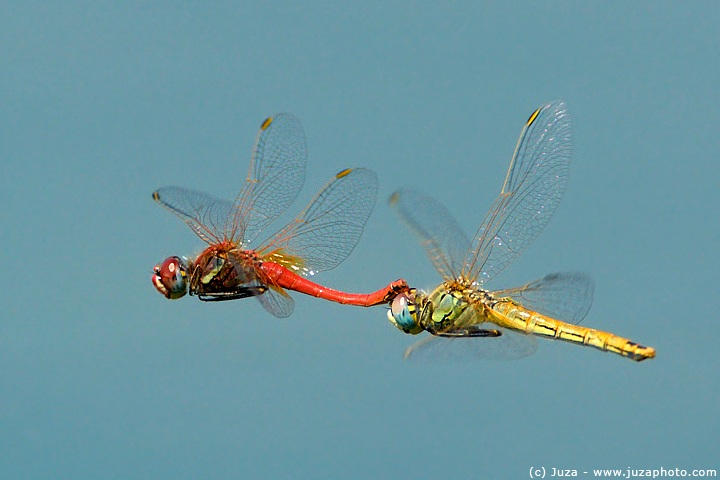
Even though I consider Torrile "a place for bird photography", sometimes there are other interesting subjects. This summer, there where hundreds of colorful dragonflies, few meters from the hide. It was very easy to photograph them on a stick or a leaf, but I was more interested to capture them in fligh, during mating, to capture a photos that is interesting both for the action and for the behavioral aspect.
The most difficult thing was to find the subject (with a focal length of 840mm, the angle of view is very narrow) and to focus, since they were continuosly moving. In this situation, the ring-type USM autofocus motor of the 600 f/4 has helped me a lot, thanks to its fast operation and, even more important, thanks to full time manual focus.
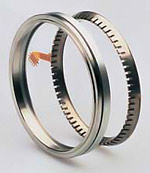
Ring-type USM motor The "so and so" autofocus of the 350D was good enough to follow the subject, but it was not able to catch the subject in first place...and of course if you don't have the subject you can't even follow it. So I decided to use the AF lock button (star button) and FTM: while I kept pressed the focus lock, I turned the large AF ring to focus manually on the subject. When the subject was reasonaly in focus, I released the AF lock, to follow the subject with the autofocus (in AI Servo mode). The great advantage of full time manual focus is that you can focus manually even if the lens is set to AF, and you can switch between AF and MF in every moment. When the camera is not able to recognize the subject by itself (here, the subject was moving quickly so the AF would have focussed on background), you can "help" the AF by focussing manually on the subject, then you can come back to autofocus to track the subject.
Even with these techs, it was not easy to capture this photo. Many times I got just two out of focus blobs of colors, while in other images the dragonflies are sharp but they are turned away from the camera. I toke many photos in continuos shooting mode; usually, after catching the subject, the AF was able to follow it for 5-6 shots. I stopped down a little (7.1) to get a bit more depth of field, since this is a pretty small subject and there was enough light to have a fast shutter speed even at f/7.1. The focal length ensured a clean, out of focus background, that complements the subject.
The lens was mounted on Gitzo 1548 tripod with Wimberley Head II - this is the perfect support for the 600 f/4; I always use it when I am in a hide. The tripod gives a little less freedom of movements than handholding, but anyway in the hides there is not much room for movement, and the Wimberley head is fantastic - it allows to follow without any effort the action, the lens is perfecly balanced and it feels weightless.
Replies and comments
What do you think about this article?
Do you want to tell your opinion, ask questions to the author, or simply congratulate on a particularly interesting article?
You can join the discussion by joining JuzaPhoto, it is easy and free!
There is more: by registering you can create your personal page, publish photos, receive comments, join discussions and you can use all the features of JuzaPhoto.
With more than 260000 members, there is space for everyone, from the beginner to the professional.
|
|
sent on 24 Luglio 2016 (9:58)
Uno scatto veramente superbo. complimenti ciao Gg |

 JuzaPhoto contains affiliate links from Amazon and Ebay and JuzaPhoto earn a commission in case of purchase through affiliate links.