The camera
Few years ago, I wrote the first version of this article: since then, things have changed a lot. While in the past you had to look to find a good camera, nowadays it is difficult to find a SLR cameras that produces bad images. Today, even a cheap, entry level camera as the Canon EOS 550D or the Nikon D90 give an image quality that you could only dream of in the age of film, and it has so many advanced features that in the past you could not even imagine: think of live view, video is SLR cameras, histogram, possibility to shoot infinite photos without spending a single dollar for film. Honestly, if you are not able to take great photos with an entry-level camera, you only have to spend more time practicing and learning - don't blame the camera!
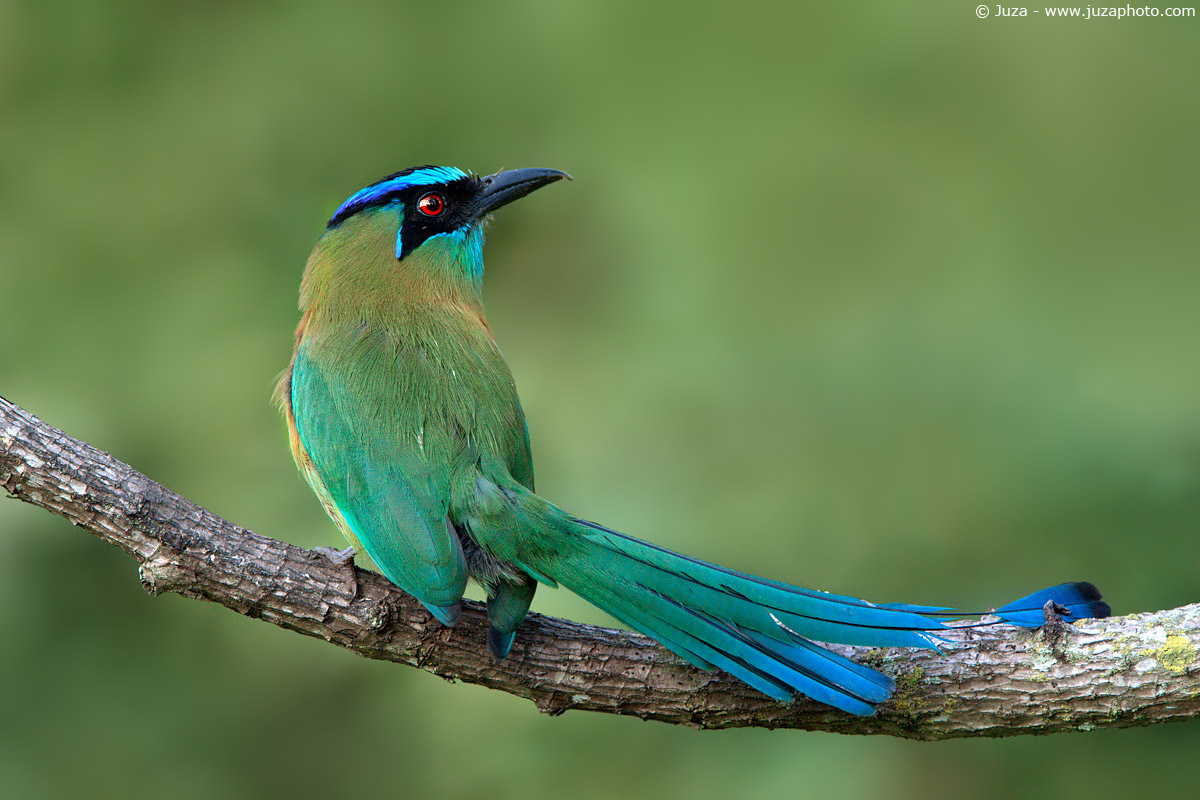
Momotus momota - Canon EOS 500D, Canon EF 300mm f/2.8 L IS USM, Canon 1.4x TC, 1/320 f/4, iso 800, handheld. Costa Rica. You don't need a professional SLR to get pro-level results. I have used for years entry-level cameras and even some of my favorite photos from the 2009 Costa Rica trip had been taken with the cheap Canon 500D.
Image quality: resolution, noise, dynamic range
The image quality is one of the most important aspects of a camera: even the most advanced camera of the world would be a bad choice if it had crappy image quality. That said, nowadays almost all SLR cameras have good image quality, even though some cameras are better than others (but none is bad).
Resolution is generally related to the pixel count, so more megapixels = more resolution (with few exceptions: the Sigma cameras have more resolution than what you may think from the pixel count, due to their peculiar Foveon sensor). In compact cameras it is a different matter because resolution is unavoidably influenced by the fixed lens, but with interchangeable lens cameras the resolution usually corresponds to the megapixels. Even the entry level cameras have at least 12-15 megapixels, enough to view the photos on huge screens or to make poster sized prints, so generally you don't have to worry about resolution. The cameras with 20-24 megapixels allows to view the photos even larger, but if you have a limited budget you can be sure that whatever camera you get, it will have good resolution.
Noise is the equivalent of film grain. As film grain, it becomes more apparent with higher ISO sensitivities. Nearly all SLR cameras currently in production are fully usable between ISO 100 and 1600 so, again, if you don't have particular necessities you can safely assume that every camera will provide good image quality, up to ISO 1600. If you plan to take a lot of photos in low light, instead, the level of noise is important in the choice of the camera. At ISO 3200, some cameras are still good, while other cameras are barely usable; from ISO 6400 upwards the majority of cameras are unusable, with very few exceptions...to be precise, with 3 exceptions: Nikon D700 (usable up to ISO 12800), Canon 1D Mark IV (usable up to ISO 12800), Nikon D3s (usable up to ISO 25600, maybe even 51200 in some situations).
Dynamic range is the range of brightness values that can be registered by the sensor: a wide dynamic range is better since it allows to capture more detail both in shadows and highlights. Nowadays, nearly all SLR cameras have a dynamic range of al least 7-8 stops, that is enough for the majority of the subjects. While sometimes I wished for lower noise, and few other times for more resolution, I have never felt the need for more dynamic range, even since I got into digital photography: sometimes this aspect of image quality is over hyped in discussion forums, but actually we already have cameras with enough dynamic range for most situations, and when it is not enough, you just have to use blended exposures, as I do for many sunrises and sunsets.
Fullframe or APS-C?
The majority of SLR cameras has either Fullframe (24x36mm) or APS-C (16x24mm) sensor. Both have their pros and cons, even though today APS-C sensors have reached an image quality that is more than enough for the majority of photographers.
The
fullframe has two advantages: extreme resolution/high ISO and wide-angle lenses. If you need a camera that is able to shoot with good quality at ISO 6400 and above, fullframe is the best, because it gives a wider surface for light collection. Indeed, nowadays the best camera on the market, in terms of high ISO capabilities, is the fullframe Nikon D3s. Other fullframe cameras, as the Canon 5D2 or the Nikon D3x, don't have amazing high ISO capabilities, but they offer very high resolution, that has not equivalent in APS-C cameras (currently the highest resolution APS-C is the Canon 7D with 18 megapixels). So, if you need either spectacular high ISO or the maximum resolution, a FF camera is the way to go.
Another advantage of FF cameras is that some lenses created for this format - Sigma 12-24, Canon 24 f/1.4, Canon 17mm TS-E and others - don't have an equivalent for APS-C, so if you need one of these, you must get a FF camera: if you use these lenses on APS-C you get a completely different angle of view...and while on a tele it is great to get more magnification, on a wide-angle is pretty annoying.
The
APS-C has one big advantage: it gives more reach than fullframe. The amount of "added reach" is not as straightforward as you may think, it is not just a matter of multiplying the focal length by 1.5x or 1.6x, but you have to take into account the pixel size. For example, if you compare the Canon 7D (APS-C, 18 megapixels, 4.3µm pixel size) with the Canon 1DsIII (fullframe, 21 megapixels, 6.4µm pixel size), the 7D has an "added reach" of 1.5x, but if you compare the old Canon 20D (APS-C, 8 megapixels, 6.4µm pixel size) with the 1DsIII (fullframe, 21 megapixels, 6.4µm pixel size), the added reach of the 20D is...none. You can crop a 1DsIII image to 8 megapixels and you will get the same 1.6x "added reach" of the 20D.
If it sound too complex for you, just remember than nowadays the majority of APS-C cameras have smaller pixels than FF cameras, so APS-C always give some added reach, even though sometimes it is not as big as it looks...but better than nothing :-) If you are choosing your first camera and you don't have much experience, I'd recommend an APS-C camera: they are less expensive than FF, and they are enough for all beginners and even for the majority of advanced amateurs and pros, unless they have the specific ISO/resolution or lens necessities I mentioned above.
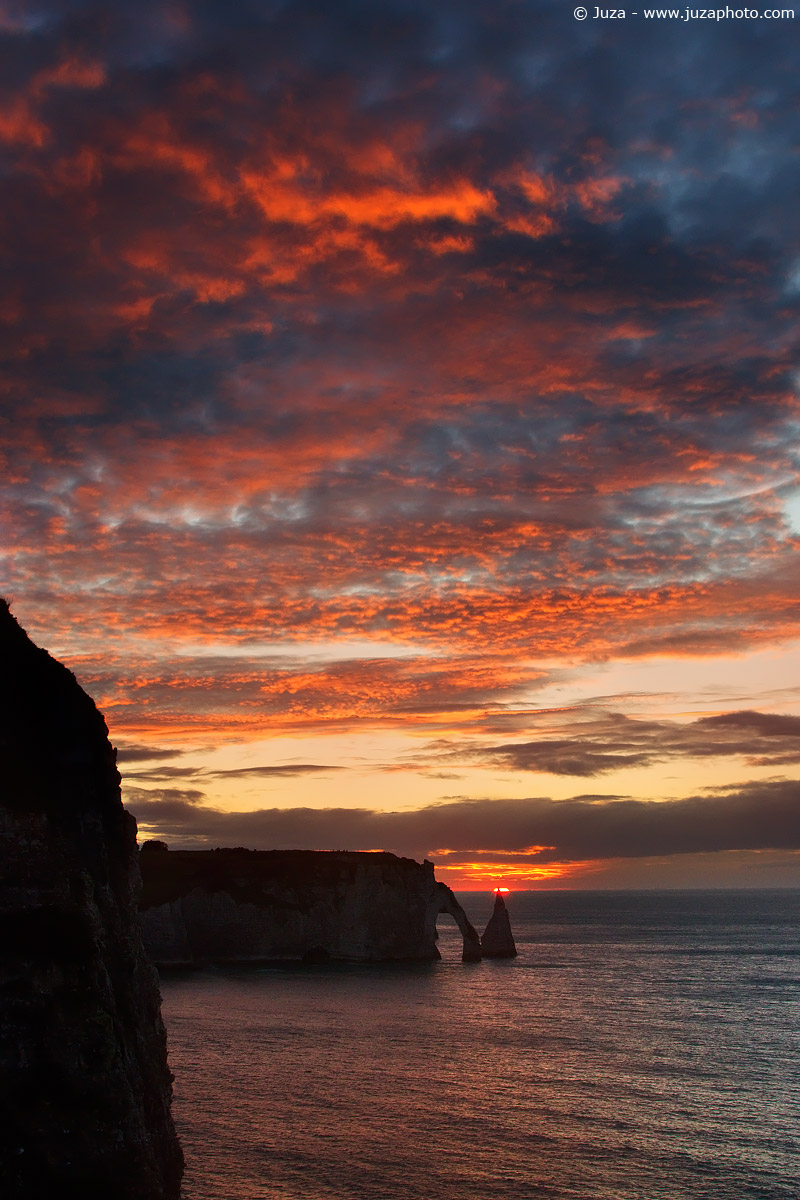
Falaises d'Etretat - Canon EOS 7D, Canon EF 24-105mm f/4 L IS USM, 1/125 f/8, iso 200, handheld. Etretat, France. The semi-pro Canon 7D is currently my workhorse.
Photographing wildlife: AF and continuous shooting
The
continuous shooting and a decent AF are important if you take photos of birds, wildlife and other fast moving subject. For everything else - landscapes, macro, studio - even the slowest AF and continuous shooting are ok. What is a good continuous shooting? 5FPS are "good enough" for wildlife; of course 8 FPS or 10 FPS are better, but if the camera has at least 5FPS, it is already a good "wildlife camera". Another aspect to take into consideration is the buffer: how many photos can you take at 5/8/10 FPS until the buffer is full? Generally, for wildlife I recommend a camera that has a buffer of at least 8-10 frames (for a 5 FPS cameras) or 15-20 frames (for 8/10 FPS cameras). The majority of semi-pro cameras currently on the market are well above these requirements; for example the Nikon D300s, Canon 7D, Olympus E-3, Sony A700, Pentax K-7 are all cameras in the $1000-$1500 price range with good continuous shooting and buffer.
The
autofocus is more difficult to judge because you can't really tell from the camera specifications - a camera may look great on paper, but in practice it may be a disappointment. That said, nowadays all SLR cameras have a good autofocus; the semi-pro and pro cameras are great, but even entry level cameras are good. In my trip to Costa Rica in November 2009 I have used the entry-level Canon 500D for wildlife and I have not had any problem with AF. The only cameras I don't recommend for their poor AF are the mirrorless interchangeable lens cameras (e.g. Panasonic GH-1, Olympus E-P2)...they are an innovative technology, but for now their AF is very limited in comparison with the AF or reflex cameras.
LCD, Live View and Video
The first digital SLRs had small, dim screens: now the technology has made big improvements, and the majority of SLRs have 3" LCDs with a resolution of 230,000 or even 900,000 pixels. The viewing angle has improved a lot, too: the most recent LCDs have a viewing angle of 160 degrees; they are very bright and easy to read even in direct sunlight.
Even though the LCD screen does not allow to judge the sharpness of the image as precisely as your computer screen, it allows to determine if the image is noticeably blurred or misfocused, using the zoom function during playback or live view.
Nowadays, nearly all cameras have
Live View, that is the possibility to frame the photo through the LCD. I consider LV essential and I'd never buy a camera that has not LV - for landscapes and macro, it is truly useful; it makes much, much easier to frame the photo and the judge the focus. Some cameras (Olympus E-3, Nikon D5000, Sony A350) have even a tilting screen, than can be "extracted" and rotated - it is a very nice thing, that makes LV even more useful.
An awesome feature found in many cameras that have live view is
video mode. The video in SLR cameras has good resolution (usually 720p or 1080p at 30FPS), great low light quality; you have a lot more flexibility than a camcorder, because you can use all your SLR lenses, you get better backgrounds and it is possible to get nice selective depth of field effects. Even though I don't take many videos, sometimes I use this feature and I am really happy to have it in my Canon 7D: it can be useful, and you don't need to carry with you a camcorder, you have everything is a single tool!
If you have some interest in video, I highly recommend to look for a SLR with video mode. (currently, all Canon cameras in production have video, with the exception of the old 1000D, 50D and 1DsIII; in the Nikon system, the D90, D5000, D300s and D3s have video)
Other things to consider
There are some features that are very important, but I have not taken them into consideration because nowadays every camera has them.
"A" and "M" mode (Aperture Priority and Manual) are essential for complete control on the exposure; histogram, highlights screen, a range of shutter speed between 30" and 1/4000, exposure compensation are all important things, but they have become the standard on all SLR cameras.
Weather sealing is a nice plus because it makes the camera a bit more resistant to rain and harsh environments, but it is not a guarantee...I have used a lot of cameras, and I have had two cameras failing due to weather: the Canon 350D (no weather sealing) and the Canon 1DsIII (weather sealed)...so at the end even the weather sealing does not guarantee that your camera will survive to rain and dust; whenever possible, try to pay a little of attention.
Almost all cameras have a
sensor cleaning function, that shakes a filter placed in front of the sensor to remove the dust. It does not guarantee to have always a clean sensor, but it is a nice help that allows to save some time and to change lenses without worrying about dust on the sensor (in the worst case, you can remove the dust by yourself with a blowing brush, it is not difficult).
An essential function, if you are seriously interested in macro and landscape photography, is
mirror lock up, that locks up the mirror some seconds before the actual exposure; it allows to avoid the blur caused by the mirror slap at slow shutter speeds. Currently the only cameras that allows to take macros without MLU are the Canon 50D, 7D and 5D2 (these cameras have MLU, but you can get the same results by shooting in live view combined with Silent Shooting Mode 1 or 2)
The
size and weight of the body varies considerably: some consumer bodies, as the Canon 450D, are very small and light, while the top professional cameras are big and bulky. If a small camera body is important for you, I'd suggest to consider a consumer or mid-range body.

 JuzaPhoto contains affiliate links from Amazon and Ebay and JuzaPhoto earn a commission in case of purchase through affiliate links.
