Gull in flight
Gull in flight, text and photos by
Juza. Published on 07 Giugno 2012; 0 replies, 3000 views.
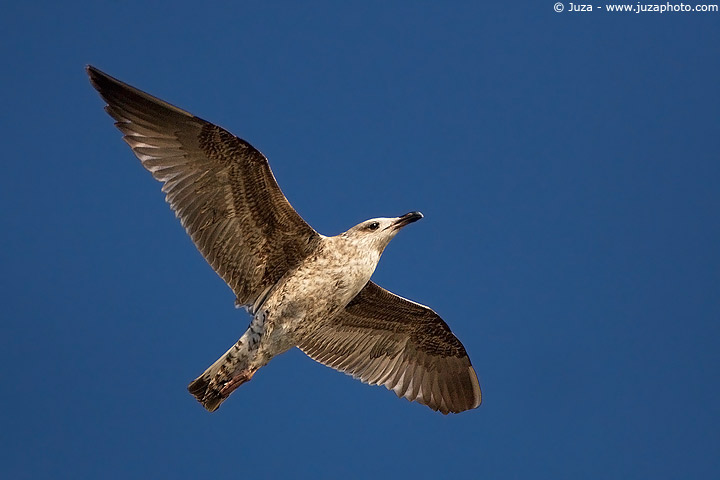
Canon EOS 20D, Canon EF 600mm f/4 L IS USM, 1/5000 f/4, iso 400, handheld. Entella river, Italy.
This is another photo taken in my recent trip on the Entella River, where I photographed many species of gulls. Photographing birds in flight is surely more challenging than photographing the classic "bird on a stick": it is easy to do something wrong, since there is little time to check the techs and the composition. One of the most common errors is to clip the tip of a wing, the tail or the bill of the subject...but there is an easy solution: you just have to leave some room all around the subject, then you can crop the photo to the perfect composition whith Photoshop. Of course, the cropping has its limits - it is ok to crop a photo to 5-6 megapixel, but you should avoid to make huge crops (i.e. cropping a photo to 1-2 megapixel), otherwise the resolution is not enough for good prints.
This is the RAW file of the photo, just converted and resized:
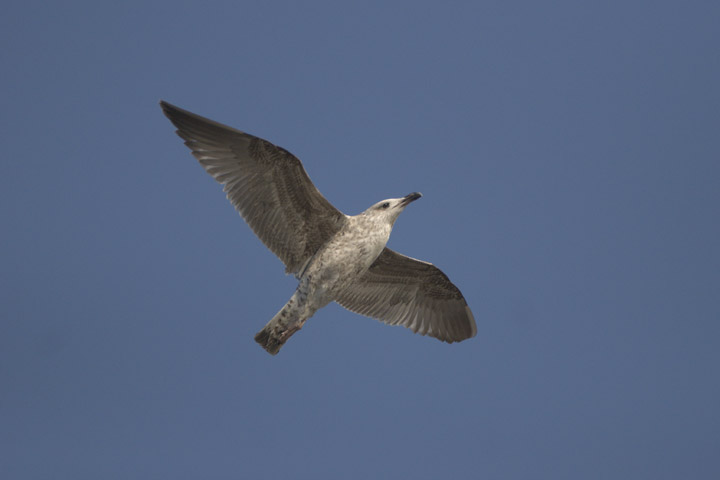
RAW file, just converted and resized, without any adjustment of contrast, sharpness, ect.
The subject is in the center of the photo: when I photograph a bird in flight, I try to keep it as much as possible into the AF area, usually there is not much time to think about composition and rule of thirds - but the empty room all around allows to crop the image to a good composition. That said, even if the photo needs some cropping, the subject is already quite large in the frame...if instead the subject is too small you have a lot of room for cropping, but you don't have enough resolution for a decent print. You should alway try to get a framing where the subject is nor too small nor clipped.
As usual, I begun to frame the subject when it is still quite distant, to help the AF to catch the subject. The 600 f/4 has a pretty fast AF, but of course you still need to do everything possible to help the AF if you want to increase the oddies of getting a sharp image. Another "trick" to improve the AF speed is using the focus limiter, if it is available on the lens. The 600 f/4, as the other superteles, as an advanced focus limiter switch with three choices: 5.5meters-infinity, 5.5mt-16.2mt, 16.2mt-infinity. Here, I set the limiter on 16.2mt-infinity: by narrowing the range of distances, the AF becomes faster and more reliable (it is less likely that it focuses on something in front of the subject).
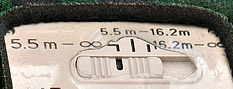
The focus limiter of Canon 600 f/4 L IS Other than framing and AF, another common error with birds in flight is overexposure, in particular with white birds. Here, I set the exposure compensation on -0.7 to preserve the brightest areas of the photo (the white feathers of the gull). Photoshop is able to recover a lot of detail in the highlights, but it is better to get the right exposure in-camera: when you photograph a bright subject against a darker background, it is often necessary to underexpose a little. Of course, I checked the exposure with the histogram, to be sure that the photo was nor overexposed nor too dark...you have to be careful with underexposure, if you underexpose too much you surely preserve the detail into highlights, but the photo become very noisy, in particular if you are already using high ISO.
Replies and comments
What do you think about this article?
Do you want to tell your opinion, ask questions to the author, or simply congratulate on a particularly interesting article?
You can join the discussion by joining JuzaPhoto, it is easy and free!
There is more: by registering you can create your personal page, publish photos, receive comments, join discussions and you can use all the features of JuzaPhoto.
With more than 257000 members, there is space for everyone, from the beginner to the professional.

 JuzaPhoto contains affiliate links from Amazon and Ebay and JuzaPhoto earn a commission in case of purchase through affiliate links.
